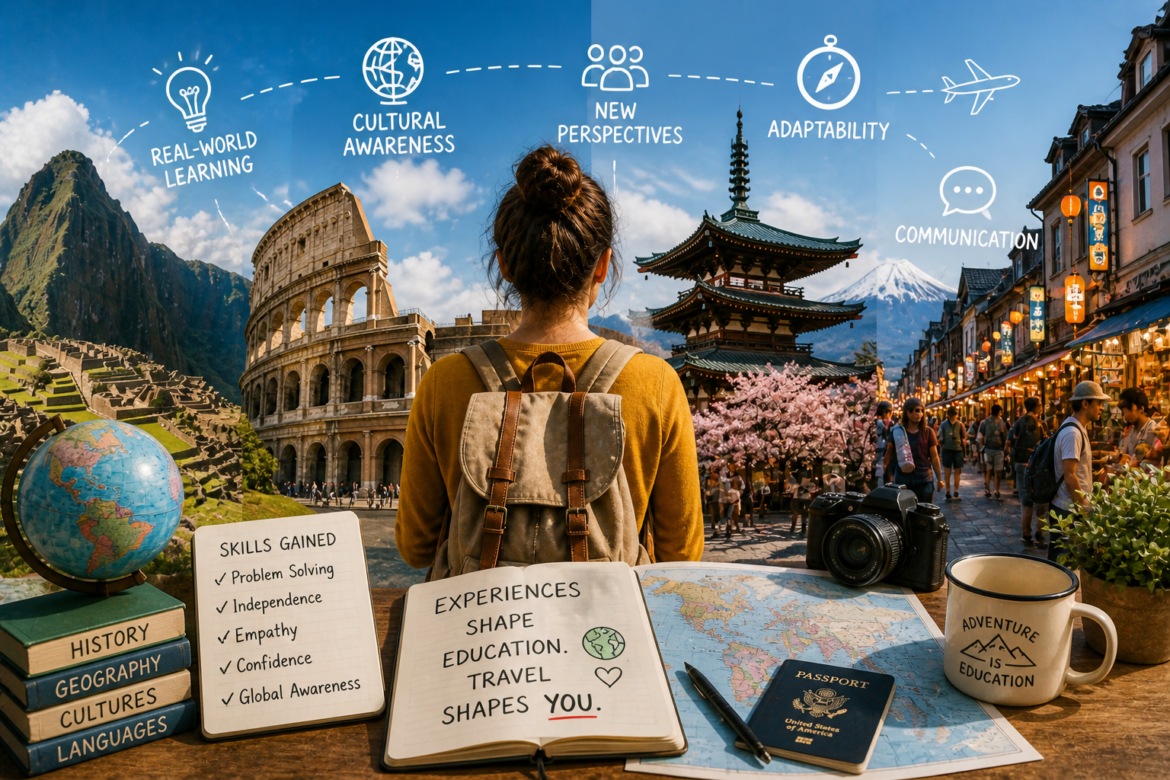
Travel is often seen as a luxury or a break from routine, but in reality, it plays a powerful role in shaping a person’s education. Beyond textbooks and classrooms, travel introduces real-world learning experiences that deepen understanding, build essential life skills, and expand perspectives.
If you’ve ever wondered how stepping outside your usual environment can actually make you smarter, more adaptable, and culturally aware, this guide breaks it down in a simple and practical way.
Travel Turns the World Into a Classroom
Traditional education gives us the foundation—facts, theories, and structured learning. Travel, on the other hand, brings those lessons to life.
When you visit historical landmarks, museums, or cultural sites, you’re no longer just reading about history—you’re experiencing it. Walking through ancient ruins or seeing famous artworks in person creates a stronger, more memorable connection to what you’ve learned in school.
For example, learning about the Roman Empire in a classroom is one thing. Standing inside the Colosseum in Rome, imagining the events that took place there, creates a deeper emotional and intellectual impact. That kind of experience is hard to replicate through books alone.
Travel also exposes you to geography in a practical way. You begin to understand distances, climates, and landscapes more clearly when you see them firsthand. Maps suddenly make more sense, and global awareness becomes second nature.
Cultural Awareness Becomes Second Nature
One of the most valuable educational benefits of travel is learning about different cultures. This goes far beyond just trying new foods or hearing different languages—it’s about understanding how people live, think, and interact.
When you immerse yourself in another culture, you start to notice differences in traditions, values, and daily routines. This exposure helps break down stereotypes and builds empathy. You begin to appreciate diversity rather than fear it.
For instance, in some countries, people prioritize community and family time over work. In others, punctuality and efficiency are highly valued. Seeing these differences firsthand helps you understand that there isn’t just one “right” way to live.
This kind of awareness is especially important in today’s globalized world. Whether you’re working remotely, collaborating internationally, or simply interacting with people from different backgrounds, cultural understanding becomes a key skill.
Travel Builds Real-Life Problem-Solving Skills
No matter how well you plan a trip, things don’t always go as expected. Flights get delayed, directions get confusing, and language barriers can make simple tasks more challenging.
These situations push you to think on your feet and solve problems independently. Unlike classroom exercises, real-life challenges don’t come with instructions or answer keys.
For example, if you miss a train in a foreign country, you need to quickly figure out alternative transportation, communicate with locals, and adjust your schedule. These experiences build confidence and resilience.
Over time, you become more adaptable and less stressed by unexpected situations. This ability to handle uncertainty is a valuable life skill that benefits both personal and professional growth.
Communication Skills Improve Naturally
Travel often puts you in situations where you need to communicate with people who don’t speak your language fluently. This encourages you to become more creative and patient in how you express yourself.
You might rely on gestures, simple words, or translation apps to get your message across. As a result, you become a better listener and a clearer communicator.
Even within the same language, cultural differences can affect communication styles. Learning to adjust your tone, body language, and approach helps you connect with people more effectively.
These improved communication skills are incredibly useful in everyday life, from job interviews to teamwork and networking.
Travel Encourages Independence and Confidence
Stepping into a new environment can feel uncomfortable at first. But that discomfort is where growth happens.
When you travel, you make decisions on your own—where to go, what to eat, how to manage your time and budget. Each successful decision builds confidence.
Even small achievements, like navigating a public transportation system or ordering food in another language, can boost your sense of independence.
Over time, you begin to trust yourself more. You realize that you can handle unfamiliar situations, which makes you more confident in other areas of life as well.
Learning Goes Beyond Academic Subjects
A well-rounded education isn’t just about academic knowledge—it also includes emotional intelligence, social skills, and practical life experience. Travel naturally develops these areas.
You learn patience when plans change. You develop empathy when you see different living conditions. You gain gratitude when you experience life outside your comfort zone.
Travel also sparks curiosity. You may become interested in learning a new language, understanding global issues, or exploring different cuisines. This curiosity encourages lifelong learning, which is a key part of a well-rounded education.
Exposure to New Perspectives Expands Thinking
When you stay in the same environment for a long time, it’s easy to assume that your way of thinking is the norm. Travel challenges that idea.
By seeing how people in other parts of the world approach life, work, and relationships, you begin to question your own assumptions. This doesn’t mean abandoning your beliefs—it means becoming more open-minded.
For example, you might notice how some cultures prioritize sustainability and minimalism, while others focus on convenience and speed. These observations can influence your own lifestyle choices.
This expanded way of thinking helps you become more flexible, creative, and understanding—qualities that are essential for both personal and professional success.
Travel Strengthens Adaptability
Adaptability is one of the most important skills in today’s fast-changing world. Travel naturally strengthens this ability.
Every destination comes with its own set of challenges—different weather, food, customs, and expectations. Adjusting to these changes helps you become more comfortable with uncertainty.
Instead of feeling overwhelmed by change, you start to see it as an opportunity to learn and grow. This mindset can be incredibly valuable in careers, relationships, and everyday life.
Networking and Global Connections
Travel also opens the door to meeting people from all over the world. Whether it’s fellow travelers, locals, or professionals, these connections can broaden your network.
You gain insights into different industries, lifestyles, and opportunities that you may not encounter in your home environment.
For example, a casual conversation with someone abroad could introduce you to new career paths, business ideas, or collaborations. These global connections can have a lasting impact on your future.
Travel Makes Learning Memorable
One of the biggest challenges in education is retention—remembering what you’ve learned. Travel helps solve this problem by making learning more engaging and memorable.
Experiences are easier to remember than facts. When you associate knowledge with a real-life experience, it sticks with you longer.
For instance, tasting authentic cuisine in a foreign country can teach you more about its culture than reading a recipe ever could. Similarly, exploring a natural landscape can deepen your understanding of environmental science.
These memorable experiences make education more enjoyable and meaningful.
Encouraging Personal Growth and Self-Discovery
Travel gives you time and space to reflect. Away from daily routines and familiar surroundings, you can think more clearly about your goals, values, and interests.
You may discover new passions, strengths, or perspectives that you didn’t notice before. This self-awareness is an important part of a well-rounded education.
Understanding yourself better helps you make more informed decisions about your career, relationships, and future.
Why Travel Should Be Part of Education
When you combine traditional learning with real-world experiences, you get a more complete form of education. Travel fills in the gaps that classrooms cannot cover.
It teaches you how to apply knowledge, interact with diverse people, and adapt to different situations. These are the skills that truly prepare you for life beyond school.
Whether it’s a short trip to a nearby city or an international adventure, every travel experience adds value to your education.
The key is not how far you go, but how open you are to learning from the journey.