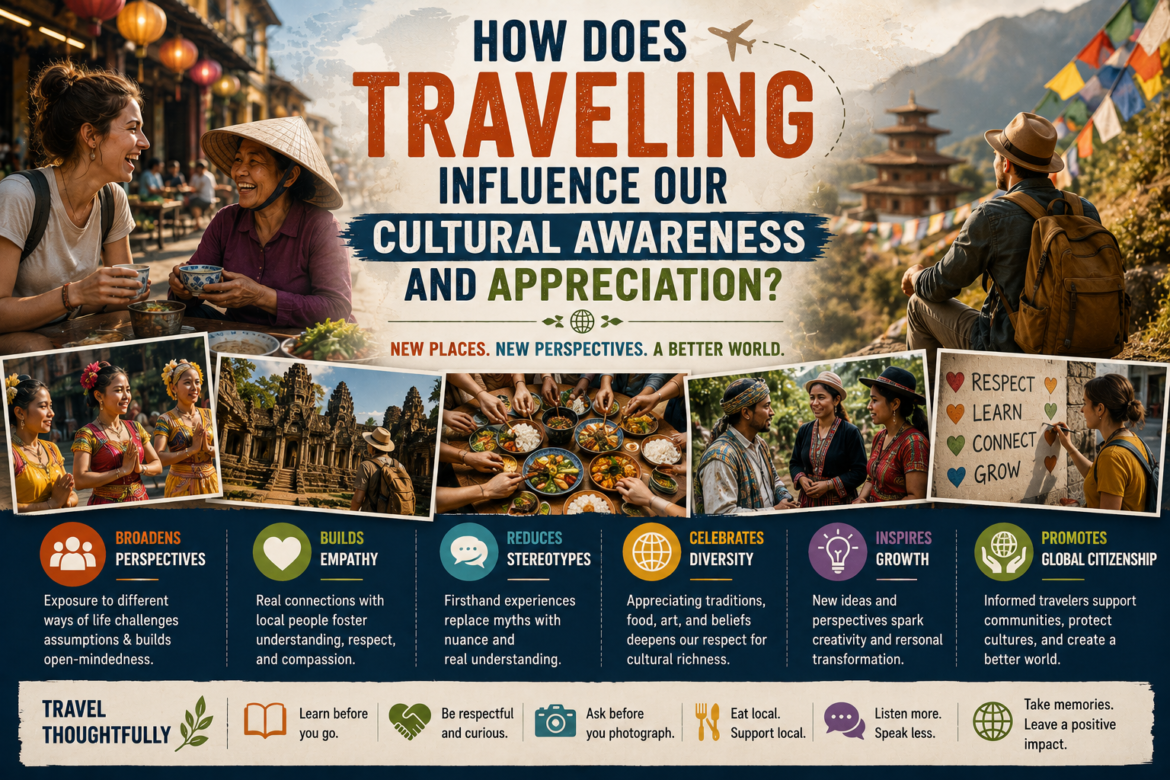
Travel opens a door to other ways of living, thinking, and celebrating. When we step outside familiar routines and environments, we begin noticing differences — in language, food, gestures, and values — and those observations gradually shape our cultural awareness and appreciation. This post explains how travel influences cultural understanding, the mechanisms behind that change, practical examples, tips to travel more thoughtfully, and how to bring cultural learning home.
Why travel matters for cultural awareness
Travel places you in real-life contexts where culture is practiced, not described. Reading or watching videos can inform you about customs, but immersion activates senses, emotions, and social dynamics. Key reasons travel deepens cultural awareness:
- Direct contact: Meeting locals and observing daily life shows how customs function in context.
- Sensory learning: Tastes, sounds, architecture, and smells create lasting impressions that facts alone can’t.
- Perspective shift: Encountering alternative ways to solve problems or celebrate life challenges assumptions about “normal.”
- Emotional engagement: New experiences evoke curiosity, empathy, surprise, or discomfort — emotions that cement learning.
- Narrative building: Personal travel stories make cultural differences meaningful and memorable.
How travel builds cultural appreciation
Travel doesn’t automatically create appreciation. It provides opportunities that, when approached openly, cultivate respect and curiosity. Here’s how that process usually works:
- Curiosity sparks attention. A traveler notices a ritual, asks questions, and starts learning the meaning behind it.
- Understanding reduces fear. Knowing why people behave a certain way removes oddness and often replaces it with admiration.
- Shared experiences create connection. Participating in local customs — attending a festival, trying home-cooked food, or learning a craft — builds empathy.
- Reframing stereotypes. Direct encounters reveal nuance, showing that stereotypes are incomplete or wrong.
- Reciprocal exchange fosters mutual respect. Locals who meet respectful, curious visitors often respond with warmth, which reinforces appreciation.
Concrete ways travel alters cultural perception
- Language and communication: Hearing accents, learning words, and seeing nonverbal cues like gestures or eye contact patterns shows that communication is culture-shaped. Even a few local phrases demonstrate respect and open doors to deeper interaction.
- Food and rituals: Trying traditional dishes reveals historical context, agricultural practices, and social values (e.g., communal eating emphasizes family and sharing).
- Time and pace: Some cultures prioritize punctuality and efficiency; others prize relationship-building and relaxed pacing. Experiencing both helps you value different approaches.
- Social norms and roles: Observing gender roles, authority structures, greetings, or hospitality norms highlights how societies organize themselves and what they value.
- Belief systems and symbols: Visiting religious sites or public rituals shows how symbols and stories guide behaviors and priorities.
Examples that illustrate the effect
- Urban immersion: A week in a bustling souk or market teaches negotiation, barter etiquette, and how commerce connects to daily life. You’ll appreciate how vendors build trust and relationships differently than at home.
- Rural homestay: Living with a local family exposes you to household rhythms, food preparation, and ceremonies, creating intimate understanding of values like hospitality and intergenerational care.
- Festival participation: Witnessing a local festival reveals layers of history, collective memory, and identity — and seeing people celebrate together makes cultural pride palpable.
- Volunteer or work exchanges: Contributing to local projects exposes you to community needs and approaches to problem-solving, often challenging assumptions about development and aid.
- Language learning stays: Even a short tandem exchange or language class shows that learning a few phrases transforms interactions and unlocks stories that otherwise remain closed.
Factors that improve cultural learning while traveling
- Intentionality: Travel with the goal to learn, not just tick tourist boxes. Read basic context before arrival and ask thoughtful questions.
- Humility: Expect to make mistakes. A humble attitude invites correction and deeper conversation.
- Curiosity: Be open to asking “why” and listening to answers without judgment.
- Presence: Slow down and spend time in neighborhoods rather than rushing between attractions.
- Local-led experiences: Choose guides, homestays, and workshops run by locals to get authentic perspectives and support local economies.
- Reflection: Journal or discuss your impressions to transform impressions into understanding.
Common pitfalls and how to avoid them
- Superficial consumption: Visiting only curated tourist spots gives a narrow view. Solution: balance iconic sites with neighborhood walks and daily markets.
- Cultural appropriation: Borrowing sacred symbols or dressing in ways that offend can harm. Solution: ask permission, learn meanings, and respect boundaries.
- Confirmation bias: Searching only for evidence that matches your beliefs preserves stereotypes. Solution: seek diverse viewpoints and check assumptions.
- Short attention spans: A rushed itinerary limits insight. Solution: stay longer in fewer places to notice routines and relationships.
- Power imbalances: Volunteer tourism can unintentionally harm local communities. Solution: choose ethical programs that prioritize local leadership and long-term benefit.
How travel influences personal identity and behavior
- Expanded empathy: Regular exposure to diverse lives cultivates empathy and lessens ethnocentrism.
- New habits: You may adopt practices such as greeting customs, food preferences, or sustainable travel habits.
- Broadened worldview: Travel can shift priorities — valuing experiences over possessions, or embracing slower pacing.
- Enhanced creativity: Exposure to different aesthetics and problem-solving styles often fuels creative thinking.
- Global citizenship: You might engage more with international issues, support fair trade, or advocate for cultural preservation.
Measuring cultural learning: practical indicators
- Ability to explain a custom’s meaning rather than only describing it.
- Comfort engaging in basic local interactions, like greeting, ordering food, or asking directions.
- Reduced reliance on stereotypes when describing a place.
- Openness to new social norms and adaptability in unfamiliar settings.
- Changes in consumption choices (buying local crafts, supporting community businesses).
Tips to travel more thoughtfully and deepen appreciation
- Learn basics before you go: read a brief history, key customs, and basic phrases.
- Choose local accommodation: homestays, guesthouses, or small family-run hotels increase cultural contact.
- Eat where locals eat: avoid tourist traps and try street food prepared by neighborhood vendors.
- Take public transport or walk: these options expose you to everyday life and reduce isolation.
- Support community businesses: buy crafts from makers directly, hire local guides, and eat at family restaurants.
- Attend community events: markets, religious services (if open to visitors), and local festivals often offer deep cultural insight.
- Ask open-ended questions: “How did this tradition start?” invites stories rather than yes/no answers.
- Keep a reflective journal: note observations, feelings, and questions to process learning.
- Respect norms: follow dress codes, ask before photographing, and observe gestures of modesty.
- Learn to apologize and accept correction with grace when you offend unintentionally.
Bringing cultural learning home
- Share stories with humility: Emphasize what you learned, not how different others are.
- Keep relationships: Maintain contact with friends you met abroad and support their work or businesses.
- Apply practices thoughtfully: Introduce recipes, language phrases, or crafts in ways that credit the origin and avoid trivializing sacred practices.
- Support cultural preservation: Donate to or volunteer with organizations that preserve languages, crafts, and traditions.
- Continue learning: Read literature, watch films, and follow creators from the places you visited.
Short checklist for respectful cultural travel
- Read a brief cultural primer before arrival.
- Learn five useful local phrases.
- Stay with or hire local hosts/guides.
- Eat at neighborhood spots.
- Ask before photographing people or sacred spaces.
- Dress according to local norms.
- Reflect on assumptions and record new insights.
Lasting Gifts of Travel
Travel is a powerful teacher. It replaces abstraction with lived experience, turns stereotypes into stories, and builds empathy through shared moments. When approached with curiosity, humility, and respect, travel expands cultural awareness and deepens appreciation in ways that last long after the trip ends.